Here is how businesses are actually using them in 2026.
According to Salesforce, sales reps still spend a large share of their time on non-selling activities, making efficiency a top priority for modern revenue teams.
Searching LinkedIn. Guessing email formats. Cross-checking company websites. Jumping between enrichment tools. Cleaning spreadsheets. Verifying contact data. For many B2B teams, lead generation still feels more manual than intelligent. That is where AI is changing the workflow.
In 2026, businesses are using free AI tools to improve prospecting, enrich lead data, automate repetitive work, and reduce friction before investing in larger sales platforms.
Some are built for outbound teams.
Some are stronger for enrichment.
Some improve CRM-led visibility.
A few only become useful when your workflows are already mature.
The challenge is not finding more tools.
It is knowing which ones actually improve lead quality, speed, and decision-making.
That is why businesses are actively comparing the best free AI lead generation tools for 2026 before committing to paid systems.
So we reviewed the most trusted tools businesses are using today based on workflow value, free-tier practicality, and where they fit best across the lead generation process.
What are the best free AI lead generation tools in 2026?
If you need a fast shortlist, these are the tools businesses are consistently using based on lead-generation stage, workflow needs, and practical free-tier value.
- Apollo AI – Best for outbound prospecting
- Clay – Best for enrichment and segmentation
- HubSpot AI – Best for CRM-led lead management
- ChatGPT – Best for outreach and personalization
- Clearbit – Best for company intelligence
- Hunter.io – Best for email discovery
- Zapier AI – Best for workflow automation
- Surfer AI – Best for SEO-led inbound growth
- Phantombuster – Best for scraping-led prospecting
- LinkedIn Sales Navigator – Best for B2B account targeting
Some are strong for prospecting.
Some improve enrichment.
Some reduce repetitive work.
A few are useful only if your workflows are already mature.
That is why businesses comparing the best free AI lead generation tool 2026 options should think in terms of fit, not popularity.
How modern AI-led lead generation actually works
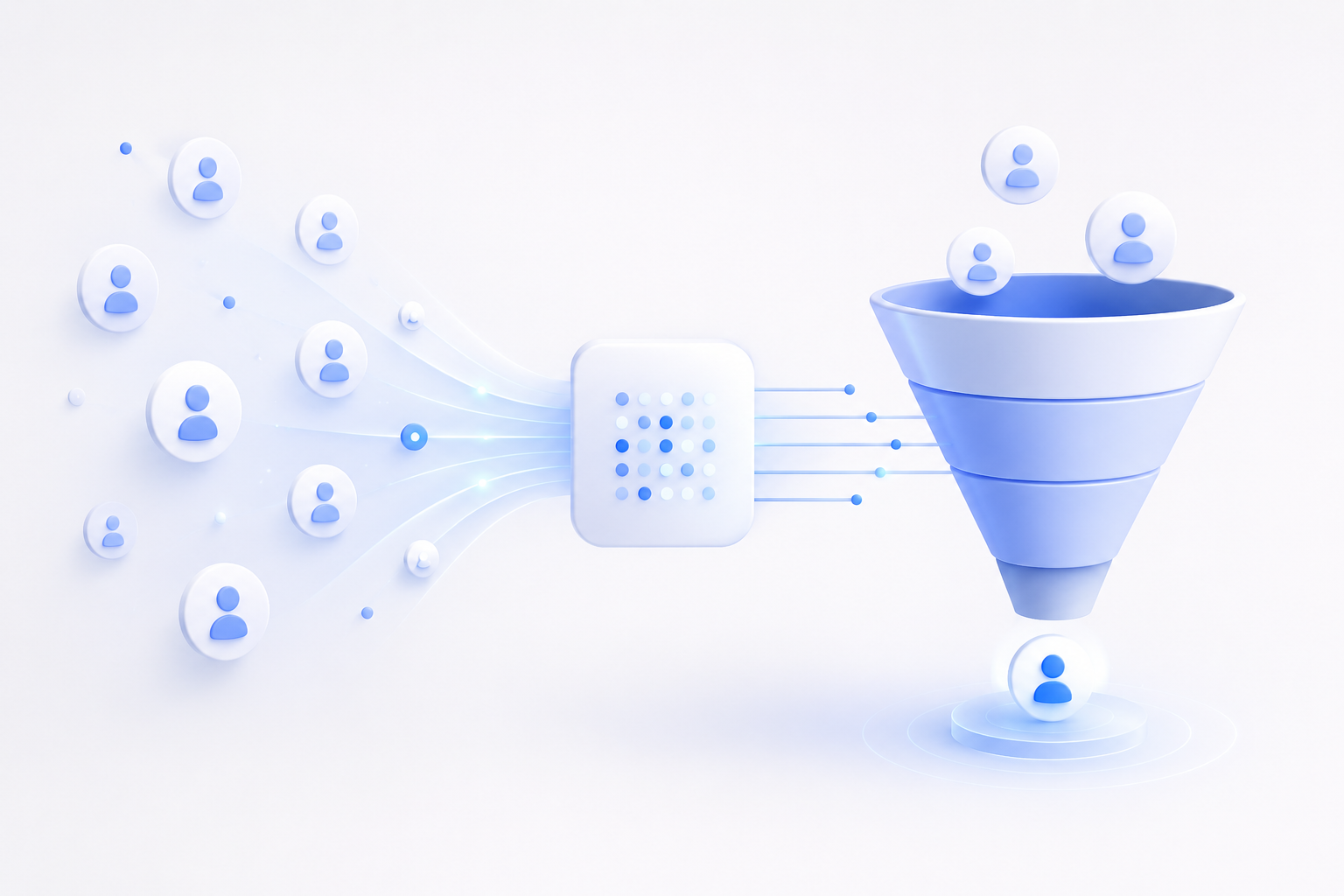
Most growth teams follow a similar workflow.
Find prospects.
Enrich lead data.
Verify contacts.
Personalize outreach.
Automate follow-ups.
Track funnel movement.
The strongest AI lead generation software supports one or more of these stages.
The smartest businesses build connected workflows, not random tool stacks.
What we looked for in a free AI lead generation tool
Not every free tool improves lead generation.
Some only automate tasks.
Some improve visibility.
Some help with outreach.
Some support CRM workflows.
The strongest tools solve real operational bottlenecks.
We assessed these tools based on practical business use.
That includes:
- Prospect discovery
- Contact enrichment
- Email verification
- Outreach support
- Workflow automation
- SEO-led lead capture
- CRM integration
- Scalability
- Free-tier usefulness
The goal was simple.
Which tools create meaningful value before businesses need to pay?
1. Apollo AI
Apollo remains one of the most widely used AI prospecting tools for B2B growth teams.
It helps businesses discover leads, enrich contact data, organize outreach, and improve targeting.
Best for outbound prospecting and structured sales workflows.
What you can actually do for free:
Build early-stage prospect lists, explore contacts, and test outbound workflows.
Build early-stage prospect lists, explore contacts, and test outbound workflows.
Its biggest strength is strong lead intelligence.
Its limitation is that deeper workflow capabilities are often reserved for paid plans.
2. Clay
Clay has become popular among RevOps teams and advanced growth operators.
It combines enrichment, scraping, segmentation, and automated logic in a single, flexible environment.
Best for layered enrichment and deeper lead intelligence.
What you can actually do for free:
Explore enrichment-led workflows and test segmentation.
Explore enrichment-led workflows and test segmentation.
Its biggest strength is flexibility.
Its limitation is setup complexity.
3. HubSpot AI + Free CRM
HubSpot remains one of the strongest ecosystems for structured lead generation.
Has free CRM and AI-assisted tools to help with lead capture, follow-ups, organization, and pipeline visibility.
Best for SMBs and growing teams.
What you can actually do for free:
Track contacts, manage lead stages, and improve CRM visibility.
Track contacts, manage lead stages, and improve CRM visibility.
Its biggest strength is operational structure.
Its limitation is the rising cost as complexity grows.
4. ChatGPT
Lead generation is not only about finding contacts.
It is also about converting them.
ChatGPT helps businesses create cold emails, personalized outreach, follow-up messaging, sales sequences, and landing page copy faster.
Best for messaging and AI-assisted personalization.
What you can actually do for free:
Improve outreach quality and accelerate content-led prospecting.
Its biggest strength is speed.
Its limitation is that it is not a lead management platform.
5. Clearbit
Some teams need a stronger company context before outreach begins.
That is where Clearbit remains useful.
It helps businesses enrich firmographic data and improve targeting.
Best for enrichment-heavy outbound teams.
What you can actually do for free:
Evaluate company intelligence and stronger-fit filtering.
Evaluate company intelligence and stronger-fit filtering.
Its biggest strength is business visibility.
Its limitation is dependence on wider sales systems.
6. Hunter.io
Smaller teams often need simpler contact discovery.
Hunter.io helps businesses find and verify professional email addresses faster.
Best for lightweight outbound prospecting.
What you can actually do for free:
Discover contacts, validate emails, and support lean lead workflows.
Discover contacts, validate emails, and support lean lead workflows.
Its biggest strength is simplicity.
Its limitation is narrower workflow coverage.
7. Zapier AI
Many leads are lost in handoffs.
Forms do not sync. CRMs lag. Follow-ups slow down.
Zapier AI automates repetitive workflows across forms, CRMs, outreach tools, scheduling systems, and business tools.
Best for workflow automation.
What you can actually do for free:
Reduce manual lead handling and build basic automation flows.
Reduce manual lead handling and build basic automation flows.
Its biggest strength is efficiency.
Its limitation is that it automates tasks, not lead quality.
8. Surfer AI
Inbound lead generation increasingly begins with discoverability.
Businesses that rank higher often attract stronger-intent buyers.
Surfer AI helps improve SEO alignment, content optimization, and organic visibility.
Best for SEO-led lead acquisition.
What you can actually do for free:
Evaluate content-led growth and search-driven lead opportunities.
Evaluate content-led growth and search-driven lead opportunities.
Its biggest strength is search support.
Its limitation is that it does not manage full lead systems.
9. Phantombuster
Some growth teams depend on scraping-led prospecting.
Phantombuster automates repetitive extraction and lead-collection workflows.
Best for advanced automation-led prospecting.
What you can actually do for free:
Test scraping workflows and automate repetitive lead tasks.
Test scraping workflows and automate repetitive lead tasks.
Its biggest strength is automation depth.
Its limitation is the technical setup.
10. LinkedIn Sales Navigator
Even in AI-led sales, relationship-driven B2B prospecting still matters.
LinkedIn Sales Navigator helps businesses identify decision-makers, track buyer signals, and improve account-based targeting.
Best for enterprise and B2B sales teams.
What you can actually do for free:
Short-term targeting evaluation and account discovery.
Short-term targeting evaluation and account discovery.
Its biggest strength is buyer visibility.
Its limitation is dependence on manual workflow layers.
Mini comparison summary: Which tool is best for your business?
If your bottleneck is prospect discovery, Apollo AI, Hunter.io, and LinkedIn Sales Navigator are stronger choices.
If enrichment matters more, Clay and Clearbit usually create better value.
If a CRM-led structure is missing, HubSpot AI offers stronger control.
If messaging quality slows conversions, ChatGPT improves personalization.
If workflows are fragmented, Zapier AI reduces operational friction.
If organic search drives acquisition, Surfer AI supports stronger inbound visibility.
That is why the best free AI lead generation tools should always be chosen based on bottlenecks, not trend value.
What most free AI lead generation tools still fail to solve
Most free tools solve isolated tasks.
Prospecting.
Enrichment.
Email verification.
Automation.
CRM visibility.
SEO support.
But businesses usually do not struggle because they lack software.
They struggle because the lead context remains disconnected.
Traffic data lives in one platform.
Prospect intelligence lives elsewhere.
Buyer signals remain scattered.
Funnel visibility stays fragmented.
That slows growth.
Why growing teams are moving toward unified lead intelligence
In 2026, businesses are reducing tool stacking. They want connected systems that improve discoverability, lead quality, workflow speed, and decision-making.
Instead of asking which tool automates a single task, teams are asking which platform improves the entire lead journey.
That includes visibility, qualification, funnel movement, and scalable growth.
This is where a stronger AI lead intelligence platform becomes more valuable than isolated automation.
For businesses moving beyond fragmented prospecting, connected systems often improve consistency and long-term acquisition efficiency.
Are free AI lead generation tools worth it?
Yes.
For startups, SMBs, agencies, and lean B2B teams, they reduce repetitive work and improve early-stage lead generation without major investment.
They help businesses validate workflows, improve targeting, and scale smarter before committing heavily.
But most companies eventually outgrow isolated free tools.
As growth expands, connected systems matter more than software count.
Smarter lead generation is becoming a competitive edge. Are you doing it?
AI is already changing how businesses discover, qualify, and convert leads.
But the teams growing faster in 2026 are not simply automating more.
They are reducing friction and improving lead intelligence.
That is why demand for the right free AI lead generation tool 2026 continues to grow.
The next growth advantage will not come from adding more tools.
It will come from better visibility, stronger lead context, and smarter systems.
FAQ
What is the best free AI lead generation tool in 2026?
Apollo AI, Clay, HubSpot AI, ChatGPT, and workflow-led tools remain strong choices depending on prospecting, enrichment, CRM, or outreach needs.
Are AI lead generation tools useful for small businesses?
Yes. Small businesses can reduce manual research, improve targeting, and accelerate sales workflows without the need for enterprise-level budgets.
Do AI lead generation tools replace CRMs?
Not always. Many improve prospecting, automation, or enrichment, while CRMs still support long-term lead tracking.
What do growing teams need after free tools?
As growth scales, businesses often move toward connected lead intelligence, stronger visibility, and full-funnel systems.
