How to Build a LinkedIn Outreach Sequence That Books Meetings on Autopilot
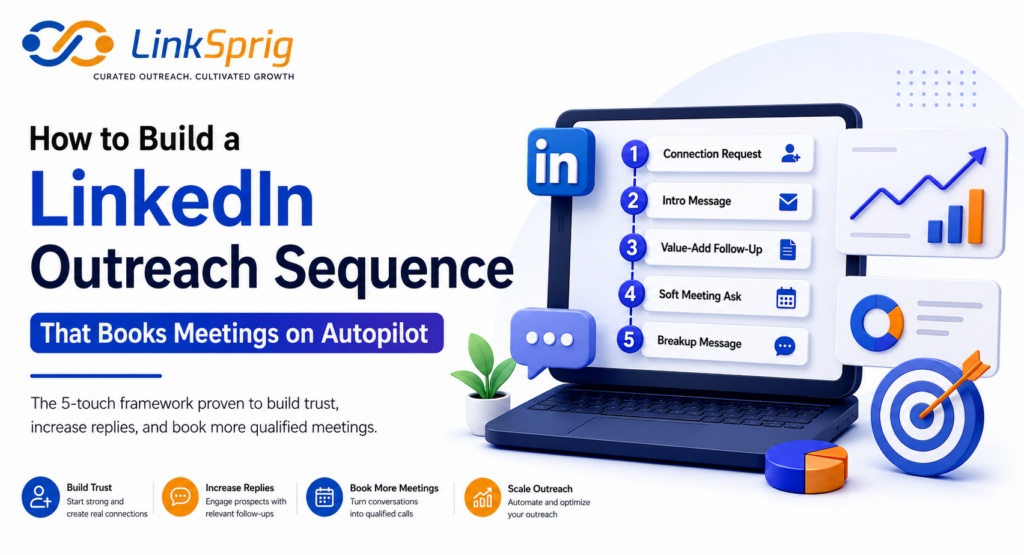
One message almost never books a meeting. It’s not because your offer isn’t good — it’s because a single touchpoint is not enough to build the trust, relevance, and urgency that moves someone from “stranger on LinkedIn” to “meeting booked.” A LinkedIn outreach sequence is how you fix that, systematically.
Here’s the reality of LinkedIn outreach: most prospects who eventually reply don’t reply to your first message. They reply to your third. Or your second. Or after your thoughtful follow-up reminded them they meant to respond two weeks ago. A single message strategy leaves the majority of your potential replies on the table.
A properly built LinkedIn outreach sequence changes the math entirely. Instead of a 5–8% reply rate on a single message, a well-executed 5-touch sequence produces 25–40% cumulative reply rates from the same prospect list.
Section 1: What a LinkedIn Outreach Sequence Is
A LinkedIn outreach sequence is a pre-planned series of messages sent to a prospect over a defined period, with each message serving a specific purpose and building on the one before it. Think of it as a conversation arc: Touch 1 → Touch 2 → Touch 3 → Touch 4 → Touch 5 Each touch has a job. Together, they move a cold prospect through a psychological journey: awareness → interest → consideration → action. The key difference between a sequence and just “following up a lot” is intentionality. Every message in the sequence adds value, advances the relationship, and respects the prospect’s time. It never repeats the same ask. It never feels pushy.Section 2: The 5-Touch Sequence Formula
Touch 1: Personalized Connection Request
Timing: Day 0. Word count: 20–40 words. The connection request note sets the tone. Make it specific to this person — reference their role, company, a post they wrote, or a challenge their industry faces. No pitch. No ask. Just a genuine reason to connect. Example: “Noticed you’re leading growth at [Company] — connecting with founders and growth leads building LinkedIn pipeline. Thought this might be a useful connection.”Touch 2: Intro Message After Connecting
Timing: 24–48 hours after connection is accepted. Word count: 60–80 words. This is your first real message. Lead with a problem they face, not a product you have. Include one specific detail about their role or company to prove you actually looked at their profile. End with a small, open-ended question — not a meeting ask. Example: “Thanks for connecting, [Name]. Most [job title]s I talk to are wrestling with [specific challenge]. We’ve been working on a way to solve that — curious if that’s on your radar too, or if the priority right now is something different?”Touch 3: Value-Add Follow-Up
Timing: Day 5–7 after Touch 2. Word count: 40–60 words. No reply yet? Don’t repeat your ask. Bring something new to the conversation — a useful article, a relevant stat, a quick insight they’d find genuinely interesting. This keeps you visible without feeling like you’re chasing. Example: “Thought this might be useful — [specific resource or insight relevant to their role]. No pressure to respond, just thought the timing was relevant given what I mentioned last week.”Touch 4: Soft Meeting Ask
Timing: Day 10–12. Word count: 40–55 words. Now you make the ask — but keep it small and frictionless. Not “are you available for a demo?” but “would a 15-minute exchange be useful?” The smaller the ask, the higher the conversion rate. Example: “[Name] — following up one more time. Would a 15-min call make sense to see if there’s a fit? Happy to work around your schedule — just suggest a time that works.”Touch 5: Breakup Message
Timing: Day 16–20. Word count: 30–45 words. The most counterintuitive message in any sequence — and often the highest-performing one. You’re closing the loop, taking pressure off, and leaving the door open. This generates replies from people who were interested but just hadn’t gotten around to it. Example: “I’ll stop reaching out after this — don’t want to clutter your inbox. If the timing ever changes, feel free to reach out. Wishing you and the team a great Q3.”Section 3: Personalization Rules for Each Touch
A LinkedIn outreach sequence only works if each message feels like it was written for this specific person. Here’s how to personalize at each stage:- Touch 1: Reference their specific role, company, or a post they wrote in the last 30 days.
- Touch 2: Name a problem specific to their industry or company stage — not a generic pain point.
- Touch 3: Make the resource or insight relevant to their specific context, not just their industry broadly.
- Touch 4: Reference the earlier conversation — “as I mentioned last week” — so it feels like a real conversation thread.
- Touch 5: Wish them well on something specific — their company’s growth, an upcoming launch, a project they mentioned.
