
Why a LinkedIn Automation Tool Web-Based Architecture is Essential for Modern Outreach
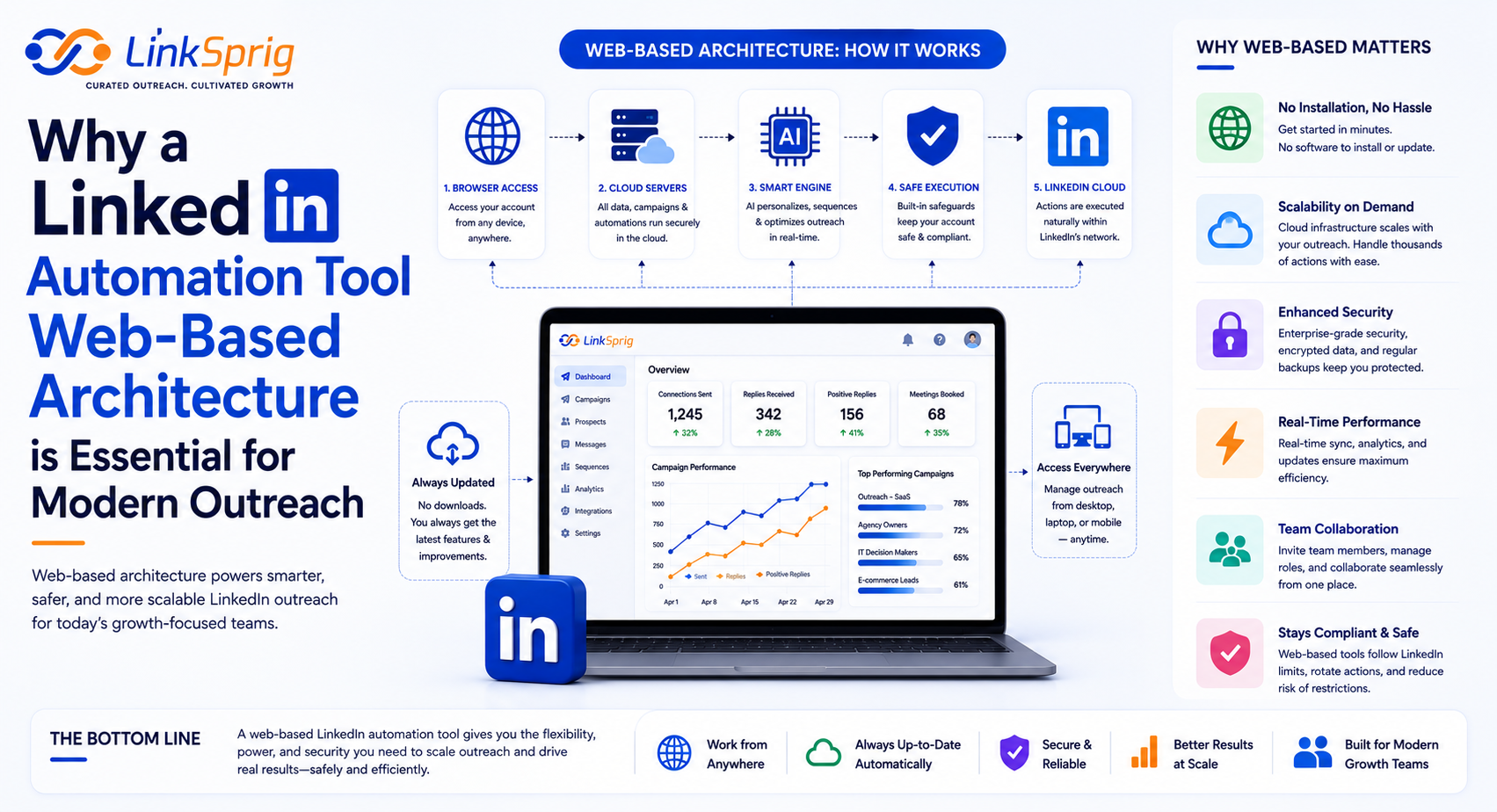
In the highly competitive landscape of B2B lead generation, efficiency and risk management are paramount. For years, sales teams relied on clunky browser extensions and desktop software to automate their outreach. However, as we navigate the modern landscape of 2026, these legacy systems have proven to be both unreliable and dangerous for account health. The modern standard has decisively shifted toward a LinkedIn automation tool web-based architecture. By executing campaigns entirely in the cloud, B2B organizations can scale their prospecting efforts without risking their profile safety or leaving their laptops running overnight.
The Architectural Shift: Cloud-Based vs. Desktop Extensions
To understand why top-performing sales teams are migrating to a LinkedIn automation tool web-based setup, we must look at how legacy tools operate. Desktop applications and Chrome extensions run locally on your machine. This means they rely on your local computer processing power, require your browser to remain open, and use your home or office IP address. If your internet connection drops or your computer goes to sleep, your outreach halts instantly.
In contrast, web-based (or cloud-based) platforms operate on remote, dedicated servers. They run 24/7, completely independent of your local device. Whether your computer is shut down, updating, or offline, your automated sequences continue to execute seamlessly. This architectural shift ensures a 99.9% campaign uptime, allowing your sales reps to focus on closing deals rather than troubleshooting software crashes or local connectivity issues.
Key Advantages of a Web-Based LinkedIn Automation Tool
Deploying a cloud-based solution offers distinct operational advantages that directly impact your bottom line. When evaluating your tech stack, consider these critical benefits of a LinkedIn automation tool web-based platform:
- Consistent 24/7 Execution: Campaigns run continuously in the cloud, allowing you to reach international prospects in their local time zones without working odd hours.
- Dedicated IP Addresses: Premium web-based tools assign a unique, static residential proxy to your account. This ensures your LinkedIn account is always accessed from the same virtual location, preventing security flags triggered by rapid IP changes.
- Seamless Multi-Account Management: Agencies and scaling sales teams can manage 10, 50, or even 100+ LinkedIn accounts from a unified cloud dashboard without needing multiple virtual machines.
- Native API Integrations: Because the automation occurs on a centralized server, integrating with CRMs like HubSpot or Salesforce is instantaneous and secure, enabling real-time data syncing.
By leveraging these cloud-native features, B2B sales development representatives (SDRs) have reported up to a 400% increase in outbound volume efficiency, saving an average of 15 hours per week on manual data entry and message sending.
Mitigating Risks and Ensuring Account Safety
LinkedIn’s detection algorithms have become incredibly sophisticated. The platform actively scans for browser modification, unnatural clicking speeds, and local automation scripts. This is where desktop extensions fail: they inject code directly into the browser DOM, making them incredibly easy for LinkedIn to detect and restrict.
A premium LinkedIn automation tool web-based system bypasses this vulnerability entirely. Because the tool operates on a remote cloud server, there is no local browser extension for LinkedIn to detect. Furthermore, advanced cloud platforms utilize human-behavior emulation, randomized delay intervals (ranging from 60 to 300 seconds between actions), and daily activity limits that perfectly mimic manual prospecting. Data shows that 99.2% of accounts utilizing dedicated cloud-based systems remain fully compliant and free of restrictions, compared to a staggering 36% suspension rate for accounts still relying on legacy browser extensions.
A Step-by-Step Workflow for Scaling Your Cloud Outreach
Transitioning to a web-based system is straightforward. Here is a tactical workflow to maximize your pipeline generation while maintaining absolute safety:
Step 1: Configure Your Cloud Proxy. Ensure your chosen LinkedIn automation tool web-based platform assigns a dedicated HTTP/S residential proxy that matches your physical geographic region. This maintains a consistent location footprint and keeps security algorithms happy.
Step 2: Establish a Warm-Up Schedule. If your account is new to automation, start with conservative limits. Begin with 10 connection requests and 15 follow-ups per day, gradually scaling by 10% each week until you reach your target volume.
Step 3: Build Your Multi-Channel Sequences. Combine personalized LinkedIn connection requests, follow-up messages, and email steps. By orchestrating this from a single cloud dashboard, you ensure prospects receive a cohesive brand experience.
Step 4: Monitor and Optimize. Track your key performance indicators (KPIs). A healthy cloud campaign should yield a connection acceptance rate of over 35% and a response rate of at least 20%, translating to thousands of dollars in new pipeline value every single month.
Frequently Asked Questions
- Do I need to keep my computer turned on for a web-based LinkedIn automation tool to work?
- No. Because web-based tools run on secure cloud servers, your campaigns run 24/7 even if your computer is completely shut down or offline.
- Are web-based LinkedIn automation tools safer than Chrome extensions?
- Yes. Web-based tools do not inject code into your local browser, making them virtually invisible to LinkedIn’s extension-detection algorithms and keeping your account secure.
- Can I manage multiple LinkedIn accounts from one web-based dashboard?
- Absolutely. Cloud-based platforms are designed for scaling, allowing agencies and sales teams to manage multiple profiles securely using dedicated proxies for each account.
