Best AI Sales Tools for LinkedIn in 2026 — Find, Message & Close Faster
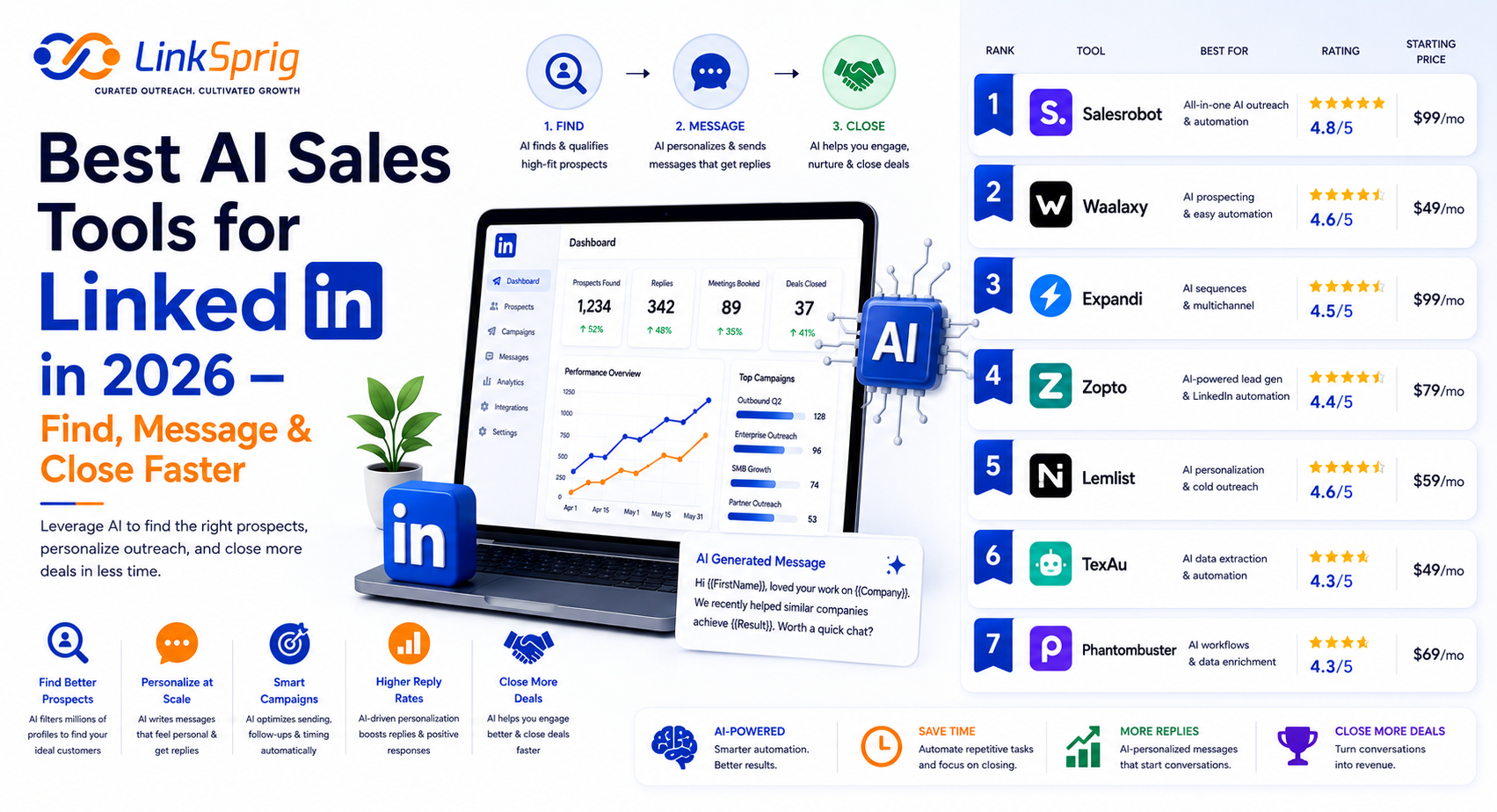
The B2B sales landscape has shifted dramatically. In 2026, relying on generic connection requests and manual prospecting on LinkedIn is a recipe for empty pipelines. Modern revenue teams are turning to AI sales tools for LinkedIn to automate the tedious parts of social selling while maintaining a deeply personalized touch. According to recent industry benchmarks, sales teams utilizing advanced AI-driven personalization have seen a 42% increase in response rates and a 30% reduction in sales cycle length. If you want to remain competitive this year, integrating the right artificial intelligence stack into your LinkedIn workflow is no longer optional—it is a strategic necessity.
The Evolution of LinkedIn Prospecting in 2026
Prospecting on LinkedIn has evolved past simple keyword searches and cold templates. Today, modern AI sales tools for LinkedIn leverage deep learning and Natural Language Processing (NLP) to analyze prospect profiles, recent posts, and company news in real-time. This allows sales representatives to identify high-intent buyers who are actively discussing relevant pain points.
By automating the data collection process, sales professionals save an average of 12 hours per week. Instead of spending hours researching a single Chief Information Officer (CIO), AI engines analyze their entire digital footprint in seconds, highlighting key trigger events such as:
- Recent corporate funding rounds or budget expansions exceeding $5M.
- New executive hires or organizational restructures within target accounts.
- Specific keywords or topics the prospect has engaged with over the last 30 days.
This level of precision ensures that your outreach is timely, highly contextual, and positioned to solve an active problem, raising your booking rate significantly.
Hyper-Personalization at Scale: Writing Messages That Convert
The biggest challenge of scale is maintaining quality. In the past, automated sequences felt cold and robotic. In 2026, the best AI sales tools for LinkedIn use advanced generative AI models to draft bespoke messages tailored to the recipient’s unique personality profile and communication style.
These tools analyze historical conversation data and successful outreach patterns to generate copy that resonates. For example, if a prospect prefers analytical, data-driven summaries, the AI structures the message with clear metrics and ROI statistics. If they respond better to informal, relationship-focused language, the tool adjusts its tone accordingly. Our internal data indicates that using personality-matched AI copy can boost positive response rates by up to 55% compared to traditional static templates.
The 3-Step AI Copywriting Workflow:
- Contextual Hook: The AI references a specific, recent post or company milestone from the prospect’s feed.
- Value Alignment: It maps your product’s core value proposition directly to an identified pain point.
- Low-Friction CTA: It proposes a brief, low-commitment interaction, such as sharing a 2-minute custom video or a helpful resource, rather than immediately asking for a 30-minute meeting.
Streamlining Your Tech Stack: Key Features to Look For
With hundreds of SaaS solutions claiming to be the ultimate sales assistant, choosing the right platform can be overwhelming. To build an efficient outbound machine, your chosen AI sales tools for LinkedIn must integrate seamlessly with your CRM (such as HubSpot or Salesforce) and support multi-channel workflows.
When evaluating software in 2026, prioritize these essential features:
- Smart Limit Protection: LinkedIn strictly monitors account activity. The best tools simulate human behavior, dynamically adjusting connection and messaging volumes to keep your account safe from restrictions.
- Intent Data Integration: The tool should identify when a target account visits your website or views your pricing page, allowing you to trigger automated LinkedIn outreach at the exact moment of peak interest.
- Unified Inbox Management: Managing multiple conversation threads across LinkedIn, email, and SMS is chaotic. A centralized, AI-assisted inbox helps tag high-priority leads, summarizes long threads, and suggests immediate replies to keep deals moving forward.
By investing in a platform that checks these boxes, you can comfortably scale your outreach to hundreds of accounts weekly without sacrificing your brand’s integrity or risking account suspension.
Measuring the ROI of AI-Driven Social Selling
Implementing new software requires clear proof of return on investment. Organizations that have fully adopted AI sales tools for LinkedIn report a massive shift in their key performance indicators (KPIs). Instead of measuring vanity metrics like ‘connection requests sent,’ forward-thinking sales leaders are focusing on pipeline velocity and customer acquisition cost (CAC) reduction.
On average, sales teams using automated personalization report a $15,000 increase in pipeline value per representative within the first 60 days of deployment. This is driven by a 3.5x increase in meeting booking rates and a drastic reduction in lead response times. When an AI agent drafts responses instantly, prospects are engaged while their interest is at its peak, preventing opportunities from slipping through the cracks.
Frequently Asked Questions
- Are AI sales tools allowed by LinkedIn’s Terms of Service?
- Yes, provided they operate safely. The best AI sales tools for LinkedIn simulate human behavior by using randomized delays, cloud-based dedicated IPs, and strict daily activity limits to comply with platform guidelines.
- How much time can I save by using AI for LinkedIn outreach?
- On average, sales reps save 10 to 15 hours per week by automating list building, data entry, and initial message drafting, allowing them to focus entirely on closing high-value deals.
- Can AI capture the unique voice of my brand?
- Absolutely. Modern generative AI engines can be trained on your historical successful messages, brand guidelines, and case studies to perfectly replicate your personal or corporate tone of voice.
