LinkedIn Automation for Marketing & Sales Agencies: Scale New Client Acquisition
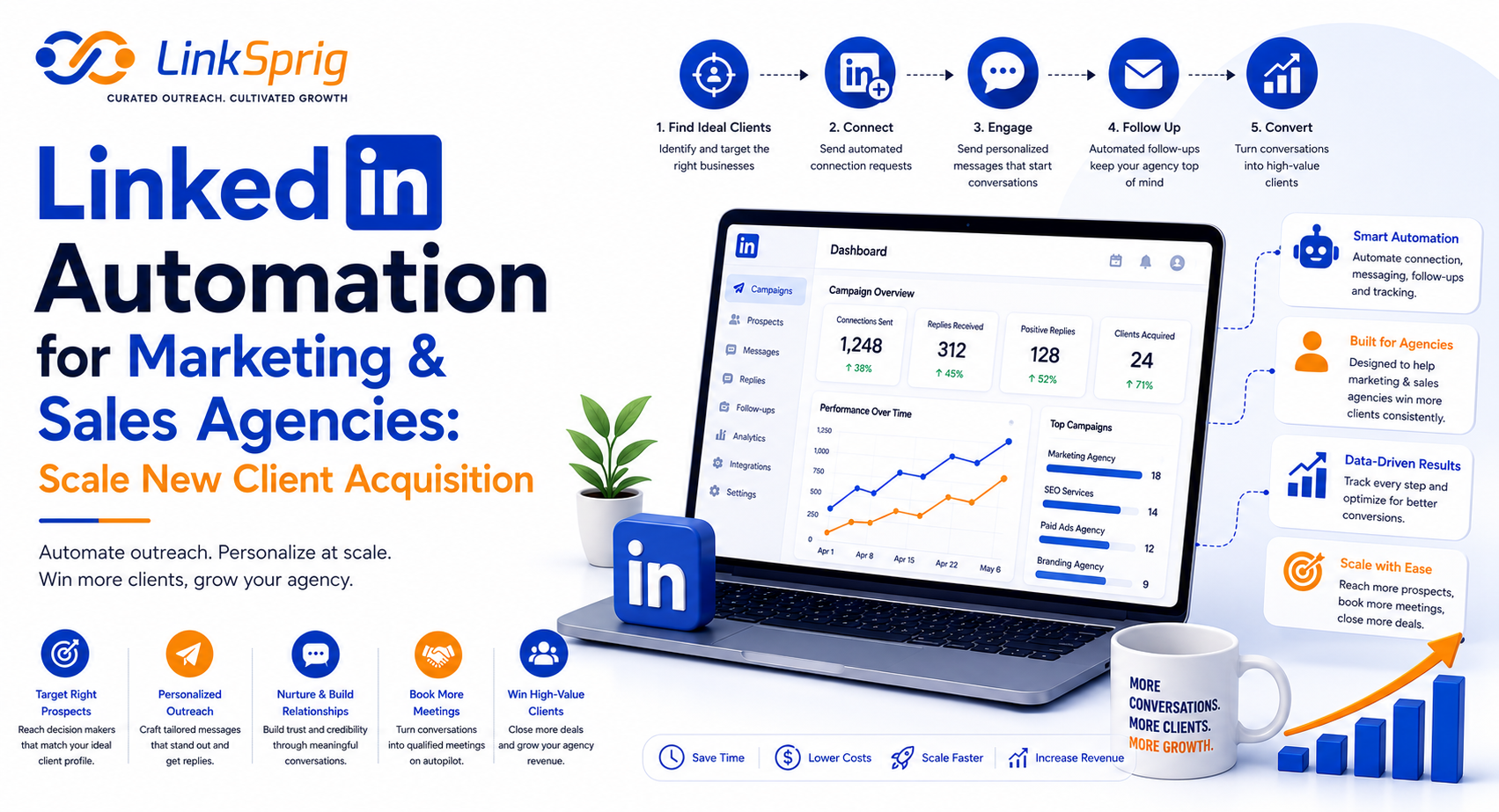
Marketing and sales agencies face a unique, recurring paradox: they are master architects of growth for their clients, yet their own internal lead generation pipelines are often neglected, inconsistent, or entirely dry. Relying solely on referrals or unpredictable inbound content is no longer a viable scaling strategy in today’s competitive B2B landscape. To build a highly predictable, scalable engine for new business, modern agencies are turning to outbound prospecting. Specifically, leveraging smart LinkedIn automation for agencies has emerged as the single most effective way to secure high-ticket B2B clients without draining billable hours. In this comprehensive guide, we will break down the exact strategies, workflows, and risk-mitigation protocols your agency needs to implement to turn LinkedIn into a 24/7 client acquisition machine.
The Agency Growth Bottleneck: Why Manual Outreach Fails
For most boutique and mid-sized agencies, the primary bottleneck to scaling is time. Account directors, growth marketers, and agency founders wear too many hats. When manual prospecting is added to their plate, it is inevitably the first task to be abandoned when client work gets demanding. Statistically, manual outreach costs agencies an average of $4,500 per month in lost billable hours per account manager who is forced to spend time manually searching, connecting, and messaging prospects on LinkedIn.
Furthermore, manual outreach lacks consistency. A successful outbound pipeline requires continuous activity. If your team only reaches out to prospects when client work slows down, you create a feast-or-famine cycle. By automating the top-of-funnel prospecting tasks, you ensure that your agency is consistently starting conversations with high-value decision-makers, even when your delivery team is at maximum capacity. This shift from manual to automated outbound can drive up to a 300% increase in qualified sales meetings within the first quarter of deployment.
Architecting the Perfect Agency Outreach Campaign
The Multi-Touch Automation Framework
Successful LinkedIn automation for agencies is not about blasting thousands of generic messages to random profiles. It requires a highly structured, multi-touch workflow that mirrors natural human behavior. To build an automated campaign that yields high reply rates from enterprise-level leads, you should follow this exact sequence:
- Step 1: Soft Touch Engagement — Automatically view the prospect’s profile and follow their public updates 2 days before sending a connection request. This builds passive familiarity.
- Step 2: The Soft Connection Request — Send a personalized, value-first connection request without a hard pitch. In 2026, connection requests with high-context, non-salesy notes achieve a 45% to 55% acceptance rate.
- Step 3: Value Drop (Day 3) — Once connected, send a message sharing a highly relevant, ungated resource (e.g., a case study showing how you solved a similar problem for a peer in their industry). Do not ask for a call yet.
- Step 4: The Soft Pitch (Day 7) — Ask a low-friction question about their current pain points. For example: “Are you currently experiencing bottleneck X with your current setup?”
- Step 5: Follow-Up & Multi-Channel Sync (Day 12) — If they haven’t replied, send a final friendly nudge on LinkedIn or push their contact data directly into an automated cold email sequence.
Advanced Personalization Tactics: Standing Out in a Crowded Inbox
B2B decision-makers are savvier than ever. They can spot a generic, automated template from a mile away. To achieve high conversion rates, your automated campaigns must look and feel completely bespoke. This is where advanced dynamic personalization variables and AI-driven icebreakers come into play.
Instead of relying on basic placeholders like first name and company name, top-performing agencies utilize advanced variables such as:
- Prospect’s Recent Activity: Referencing a specific post they commented on or shared within the last 30 days.
- Hiring Intent: Tailoring your message based on open job roles at their company. For example, if you are a creative agency and they are hiring a graphic designer, your automation can trigger a message offering fractional design support to bridge the gap.
- Technology Stack: Segmenting your prospect list based on the software they use (e.g., targeting companies using HubSpot with a specialized HubSpot optimization offer).
By segmenting your lead lists into hyper-specific micro-cohorts of 50-100 prospects, you can write highly targeted copy that reads like a 1-to-1 manual email, achieving response rates upward of 28%.
Risk Mitigation and Safety Protocols in 2026
While the benefits of outbound automation are undeniable, maintaining account safety is paramount. LinkedIn continuously refines its algorithms to detect and restrict accounts that exhibit spammy or bot-like behavior. To protect your agency’s personal profiles and your clients’ reputations, you must adhere to strict safety guardrails.
First, always utilize a cloud-based automation tool that assigns a dedicated, residential IP address matching your local geographic area. This prevents LinkedIn from flagging your account for concurrent logins from different locations. Second, strictly limit your daily activity. In 2026, safe operational limits dictate sending no more than 20-25 connection requests per day (or roughly 100-120 per week) and keeping your total daily messages (including follow-ups and group messages) under 80. Finally, ensure your automation software features randomized delays between actions (e.g., waiting between 3 to 7 minutes between profile views and messages) to mimic authentic human interaction patterns perfectly.
Frequently Asked Questions
- Is LinkedIn automation safe for agency profiles in 2026?
- Yes, LinkedIn automation is safe as long as you use premium, cloud-based tools that utilize dedicated residential IPs and mimic human behavior. You must strictly adhere to daily limits (under 25 connection requests per day) and focus on highly personalized, low-volume outreach rather than mass spamming.
- How do we integrate LinkedIn automation with our agency CRM?
- Modern LinkedIn automation platforms support native integrations or Webhooks (via Zapier or Make). This allows you to automatically push positive replies, contact details, and conversation histories directly into CRMs like HubSpot, Salesforce, or Close, ensuring your sales team can follow up instantly.
- What is a realistic response rate for automated agency outreach?
- When targeting a highly defined ICP with personalized, value-first messaging (rather than direct pitching), agencies typically see connection acceptance rates of 40-50% and reply rates of 15-25% on their follow-up sequences.
