How to Personalize LinkedIn Messages at Scale: The 2026 Playbook
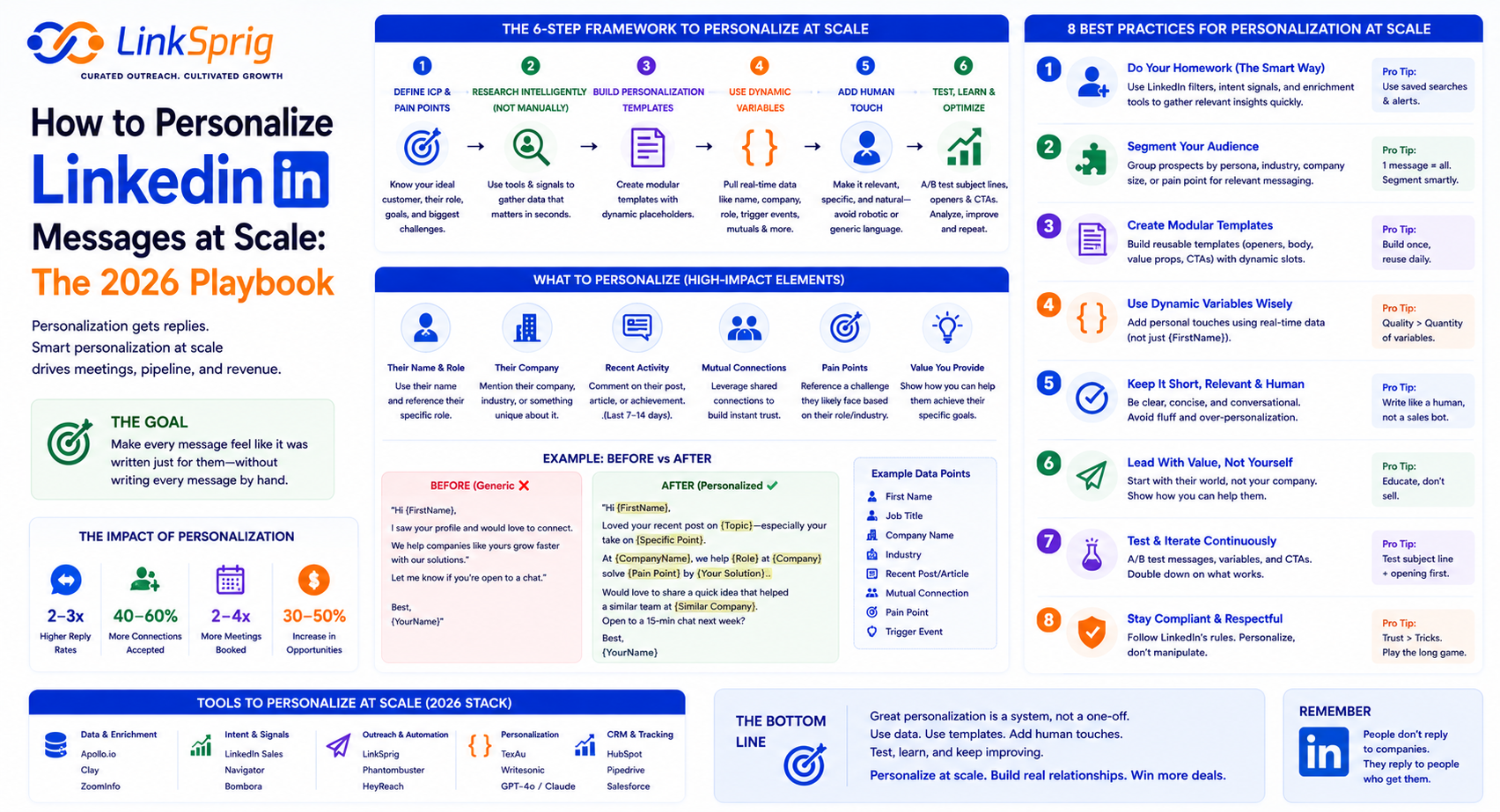
In the highly competitive B2B SaaS landscape, outbound sales teams face a brutal paradox: manual personalization is incredibly slow, yet generic automated spam is completely dead. In 2026, relying on basic templates with just a first name variable results in an abysmal 1.2% reply rate and puts your LinkedIn account at risk of restriction. To build a robust pipeline, modern growth leaders must master how to personalize LinkedIn messages at scale. By combining advanced audience segmentation, structured data scraping, and generative AI engines, you can achieve reply rates of 15% to 22% without spending hours drafting individual messages. This guide outlines the exact, data-driven framework to automate your personalization workflow while retaining a deeply human touch.
The Personalization Paradox: Why Generic Automation Fails
For years, the standard outbound playbook was simple: scrape a list of 1,000 prospects, load them into a legacy automation tool, and blast a generic message. Today, LinkedIn’s algorithm and user base have evolved. Sophisticated spam filters and a collective fatigue toward automated pitches mean that cold outreach must adapt. Recent data from 2026 shows that hyper-personalized campaigns generate a 310% higher response rate compared to traditional automated campaigns.
When you understand how to personalize LinkedIn messages at scale, you bridge the gap between volume and quality. The goal is no longer to send 500 messages a week; the goal is to send 100 highly targeted, context-rich messages that make each recipient feel like you spent 15 minutes researching their profile. By leveraging structured data points such as recent promotions, company hiring trends, or shared mutual connections, you can scale your outreach without sacrificing your brand’s reputation.
The 3-Step Framework for Scalable Personalization
Executing a scalable personalization strategy requires a systematic approach to data collection and message construction. Here is the exact workflow used by top-performing B2B growth teams in 2026:
1. Hyper-Segment Your Audience
Before writing a single line of copy, you must segment your prospects into micro-cohorts. Instead of targeting ‘All Marketing Directors in North America,’ narrow your list down to ‘Marketing Directors in the Cybersecurity space who have been in their role for less than 90 days and are actively hiring.’ This level of granularity allows you to use highly relevant, situational pain points in your messaging.
2. Map Out Dynamic Variables
Move beyond basic variables like [First Name] and [Company]. To truly stand out, integrate advanced dynamic variables into your outreach sequences. Consider utilizing the following data points:
- [Prospect Pain Point]: Specific to their micro-cohort (e.g., rising customer acquisition costs in SaaS).
- [Trigger Event]: A recent company milestone, such as a new round of funding, a product launch, or executive hiring.
- [Specific Asset]: Mentioning a specific piece of content they recently published or engaged with.
- [Shared Experience]: A mutual alma mater, former employer, or shared geographic hub.
3. Deploy Generative AI for Contextual Customization
Once your data is structured, you can feed these variables into an AI-driven personalization engine like LinkSprig. The AI analyzes the prospect’s profile data and instantly drafts a natural-sounding hook that references their specific achievements, seamlessly tying it into your value proposition.
Maximizing Efficiency and Safety: The Math of Scaled Personalization
Many sales leaders worry that implementing a sophisticated personalization workflow will bottleneck their pipeline. However, the math proves otherwise. Let’s look at a comparative breakdown of a standard SDR’s weekly output in 2026:
- Traditional Spam Model: 500 generic messages sent -> 1.5% reply rate -> 7.5 replies -> 1 booked meeting. Total time spent: 5 hours.
- Scalable Personalization Model: 150 hyper-personalized messages sent -> 18% reply rate -> 27 replies -> 6 booked meetings. Total time spent: 3 hours (using LinkSprig’s automated workflows).
By learning how to personalize LinkedIn messages at scale, you not only save 2 hours of manual labor per week, but you also increase your booked meetings by 500%. Furthermore, sending fewer, high-quality messages protects your LinkedIn sender reputation, keeping you well within the platform’s daily activity limits (typically capped at 50-80 actions per day in 2026).
Battle-Tested Templates and Workflows to Implement Today
To help you get started immediately, here is a highly effective template structure designed for scaled personalization. This template leverages a ‘Trigger Event’ framework:
“Hi [First Name], saw that [Company] recently launched your new [Product/Feature]—congrats on the milestone! I noticed many [Job Title]s in the [Industry] space are currently struggling with [Pain Point] as they scale. We recently helped a similar team boost their conversion rates by 24%. Would you be open to a brief exchange of ideas on how we tackled this?”
By dynamic-mapping the [Product/Feature], [Job Title], [Industry], and [Pain Point] fields through your CRM and LinkedIn automation platform, you generate a message that feels completely bespoke. The prospect assumes you have deeply analyzed their business, yet the entire process is automated behind the scenes. This is the ultimate execution of how to personalize LinkedIn messages at scale.
Frequently Asked Questions
- Will automating personalization get my LinkedIn account restricted?
- Not if done correctly. LinkedIn restricts accounts that send high volumes of generic, rapid-fire messages. By sending fewer, highly personalized messages (under 50-80 per day) with natural delays, you mimic human behavior and stay completely safe.
- How do I gather the data needed for advanced personalization variables?
- You can leverage tools like LinkedIn Sales Navigator, combined with data enrichment platforms and LinkSprig, to automatically extract profile data, recent posts, and company news into structured CSV files.
- Does AI-personalized outreach actually sound natural?
- Yes, when combined with well-defined templates and advanced LLMs. The key is to use AI to generate only the ‘hook’ or ‘icebreaker’ based on structured data, while keeping the core value proposition clear, concise, and human-written.
