LinkedIn Outreach Best Practices in 2026: The Ultimate B2B Playbook
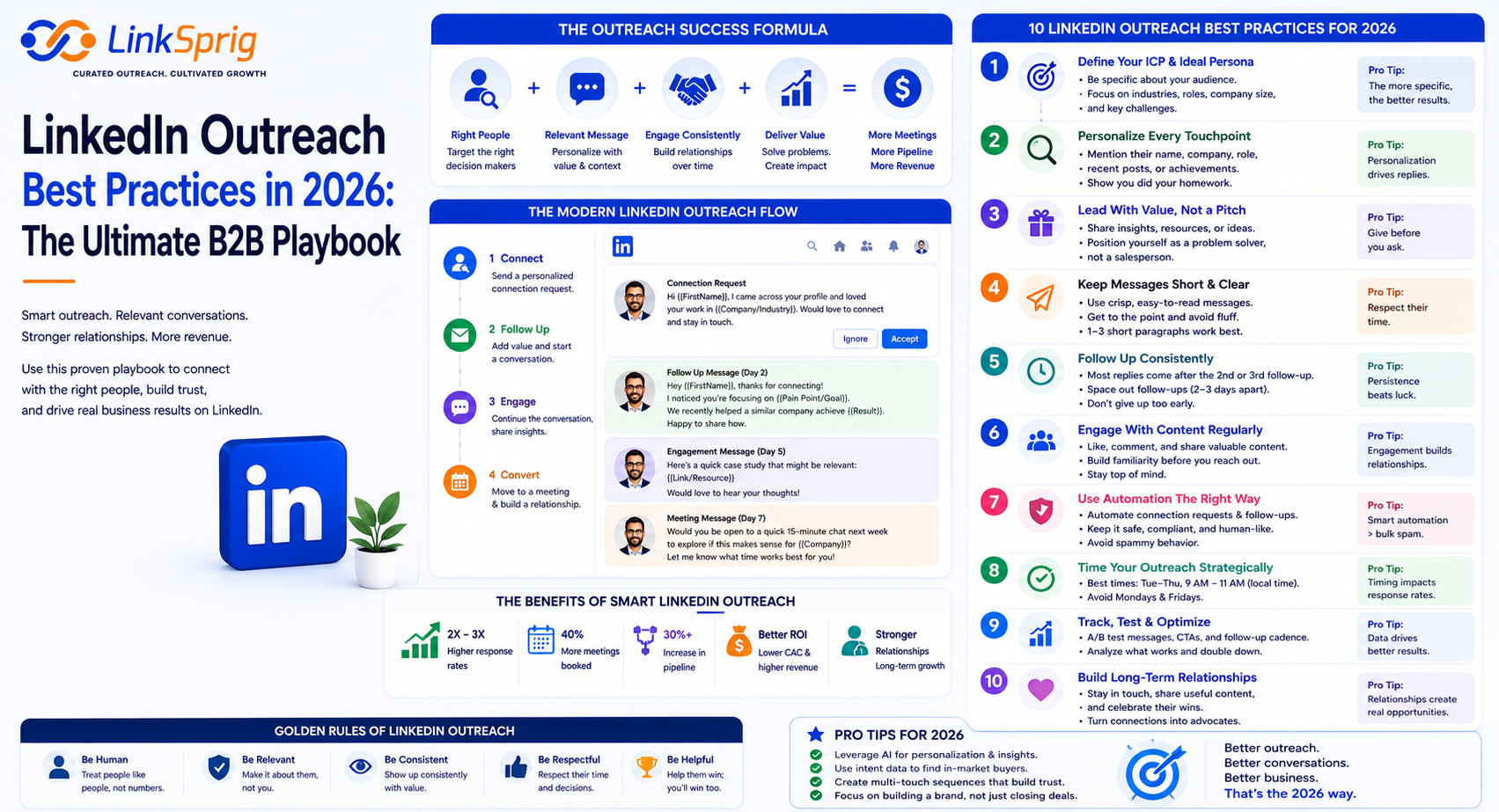
The B2B sales landscape has undergone a seismic shift. As we navigate 2026, the era of spray-and-pray LinkedIn automation is officially dead. LinkedIn’s algorithmic updates have cracked down hard on automated spam, prioritizing genuine peer-to-peer engagement and high-value interactions. To stand out in a noisy inbox, modern sales development representatives (SDRs) and growth marketers must adapt to a new set of rules. This guide breaks down the essential LinkedIn outreach best practices 2026 that top-performing revenue teams are using to book enterprise-level meetings and build sustainable, high-yield pipelines.
1. Algorithmic Realities: Navigating Trust Scores and Sending Limits
In 2026, LinkedIn’s spam detection engine relies heavily on user-specific Trust Scores. This internal metric determines your daily and weekly reach limits. While the standard connection request limit remains capped around 100 per week for average accounts, users with high Trust Scores—driven by high acceptance rates and low ‘I don’t know this person’ flags—can unlock up to 250 highly targeted requests weekly. Mastering these LinkedIn outreach best practices 2026 is critical to maintaining a healthy sender reputation and ensuring your messages actually land in the inbox.
To optimize your account’s health, you must focus on your Social Selling Index (SSI). Recent 2026 data shows that accounts maintaining an SSI score above 78 experience a 38% increase in message deliverability and a significantly reduced risk of account restriction.
Key Actions for Account Health:
- Warm Up Your Profile: Spend 10-15 minutes daily engaging with posts in your feed before sending outbound messages to signal natural user behavior.
- Prune Outstanding Requests: Regularly withdraw connection requests older than 14 days to keep your pending queue under 50.
- Optimize Your Profile for Conversion: Ensure your headline speaks directly to the business outcome you deliver, rather than just your job title.
2. Beyond First Name Tags: The Hyper-Personalization Standard
Generic personalization like ‘I saw you work at [Company]’ no longer works. Buyers in 2026 can spot templated AI outreach instantly. High-performing campaigns now leverage hyper-personalization based on deep contextual triggers. By analyzing real-time intent data, hiring trends, and executive transitions, you can craft messages that feel uniquely tailored and impossible to ignore.
According to recent B2B benchmarks, campaigns utilizing advanced intent-based personalization achieved an outstanding 42% response rate, compared to a meager 6.5% for traditional sequence templates. This highlights the importance of incorporating modern LinkedIn outreach best practices 2026 into your daily prospecting workflow.
High-Converting Personalization Triggers:
- Recent Departmental Hires: Congratulate prospects on a new leadership hire in their department and tie it to a common scaling challenge.
- Content Engagement: Reference a specific comment they made on an industry influencer’s post, adding your own valuable perspective.
- Technology Stack Changes: Identify if they recently adopted or dropped a competitor’s software to position your solution timely.
3. The Multi-Touch Relationship Workflow
Successful outreach is rarely a single-step process. In 2026, the most effective workflow spans multiple days and touches, building familiarity before any direct pitch is made. This ‘soft-touch’ approach warms up prospects and drastically increases connection acceptance rates. A proven 8-day sequence looks like this:
- Day 1: Profile View & Follow: Visit the prospect’s profile to trigger a notification, and click ‘Follow’ to start seeing their content.
- Day 3: Value-First Engagement: Leave a thoughtful, insightful comment on one of their recent posts or a post they engaged with. Do not pitch.
- Day 5: The Frictionless Connection: Send a connection request with a short, personalized note referencing the shared industry topic—still no sales pitch.
- Day 8: The Value Drop: Once connected, send a highly relevant, ungated asset (e.g., a case study showing a 150% ROI for a similar company) that addresses a specific pain point.
4. Measuring What Matters: Core Metrics for 2026
Vanity metrics like connection acceptance rates can be deceptive. In 2026, top-tier revenue teams measure success by Reply-to-Meeting Conversion Rate and Pipeline Velocity. A campaign with a 30% acceptance rate but a 15% meeting-booked rate is infinitely more valuable than a 70% acceptance rate that yields zero qualified opportunities.
To maximize your return on effort, audit your campaigns weekly and ruthlessly eliminate sequences that fail to generate meaningful sales conversations within 14 days. Aim for a target response-to-meeting conversion rate of at least 12% to ensure your outreach remains highly profitable and scalable.
Frequently Asked Questions
- What is the weekly connection request limit on LinkedIn in 2026?
- While LinkedIn officially enforces a soft limit of around 100 connection requests per week, accounts with high Trust Scores and high engagement ratios can safely send up to 200-250 requests per week using personalized, highly targeted outreach.
- Is LinkedIn automation still safe to use?
- In 2026, strict, fully automated spam tools are highly risky and easily detected. However, hybrid automation—where tools are used to assist with research, queue messages, and manage workflows while keeping the actual personalization and sending organic—is the industry standard for safe, scalable outreach.
- How long should my LinkedIn outreach messages be?
- Keep them under 100 words. Data shows that short, punchy messages of 50-75 words that focus on a single question or value proposition receive up to 60% more responses than long-form pitches.
