
LinkSprig

Category E — Lead Generation & Pipeline Building

Category E — Lead Generation & Pipeline Building

LinkedIn Lead Generation for B2B Companies UAE: How to Reach Dubai’s Top Decision Makers

The United Arab Emirates—particularly Dubai and Abu Dhabi—has rapidly evolved into a hyper-competitive global business hub. For B2B organizations looking to expand their footprint in the Middle East, the region offers unparalleled opportunities. However, traditional cold outreach methods often fall flat against the highly guarded gates of UAE enterprise executives. To successfully build a predictable sales pipeline in this market, modern sales teams must master LinkedIn lead generation for B2B companies UAE. By leveraging localized personalization, advanced filtering, and relationship-first workflows, you can bypass traditional gatekeepers and secure high-value partnerships with Dubai’s top decision-makers. The UAE B2B Landscape: Why LinkedIn is Your Golden Ticket in 2026 With over 8 million active users in the United Arab Emirates, LinkedIn has evolved from a simple networking site into the primary operating system for Middle Eastern business development. In 2026, data shows that 73% of decision-makers in Dubai actively use LinkedIn to source B2B solutions, research vendors, and establish strategic partnerships. This makes the platform an indispensable asset for high-growth SaaS, consulting, and enterprise service providers. However, doing business in the UAE requires a deep understanding of local corporate structures. The market is highly diverse, consisting of: Government-Backed Entities (GREs): Large-scale organizations where hierarchy and formal protocols are highly valued. Free Zone Companies: Highly agile businesses operating in zones like DIFC, DMCC, or ADGM, which are often more receptive to innovative global SaaS solutions. Multinational Corporations (MNCs): Regional headquarters managing operations across the entire MENA region. To succeed with LinkedIn lead generation for B2B companies UAE, your campaigns must be tailored to these specific segments rather than relying on a generic, one-size-fits-all global outreach template. Hyper-Targeting Dubai & Abu Dhabi Decision Makers: A Tactical Workflow Reaching the right executive requires surgical precision. Standard search filters often yield noisy results, but by utilizing LinkedIn Sales Navigator, you can isolate high-intent prospects with ease. Use this tactical workflow to build your UAE prospect list: Geographic Segmentation: Filter by “United Arab Emirates” or drill down specifically into the “Dubai Metropolitan Area” or “Abu Dhabi” to match your regional sales focus. Industry & Department: Focus on high-growth sectors such as Financial Services, Information Technology, Real Estate, and Logistics. Target “Decision Maker” seniority levels (VPs, Directors, and C-Suite). Company Type & Headquarters: Filter by companies headquartered in the UAE to locate local decision-makers, or target regional subsidiaries of global firms. Connection Activity: Filter for prospects who have posted on LinkedIn in the past 30 days. This ensures you are reaching active users, which typically boosts response rates by up to 35%. By refining your list to a highly targeted segment of 200 to 300 prospects at a time, you can craft highly personalized messaging that addresses the specific economic and operational realities of the UAE market. Crafting the Perfect UAE-Centric Outreach Campaign In the Middle East, relationships precede transactions. A aggressive, hard-selling pitch in your first connection request will result in an immediate block. Instead, your outreach sequence should focus on building trust and offering immediate, localized value. When launching a campaign targeting Dubai executives, follow these communication principles: Lead with Respect and Professionalism: Address prospects by their proper titles. Professional etiquette is highly valued in UAE business culture. Leverage Local Social Proof: Mentioning work you have done with other Middle Eastern or GCC-based brands can increase your response rates by over 45%. If you do not have local clients yet, focus on global case studies that address challenges directly relevant to the UAE’s rapid digital transformation goals. Offer Low-Friction Value: Instead of asking for a 30-minute demo right away, invite them to view a localized industry report, an exclusive executive roundtable, or a quick 2-minute personalized video audit. Data from successful campaigns in 2026 shows that B2B companies utilizing this relationship-first framework achieve average connection acceptance rates of 42% and positive response rates between 18% and 24%. Scaling Your Pipeline: Automation and Compliance in the Middle East While personalization is critical, scaling your B2B lead generation requires the right technology stack. Using advanced LinkedIn outreach automation platforms like LinkSprig allows your sales team to scale personalized touchpoints without losing the human touch. Automation should be used to handle the heavy lifting of profile visits, connection requests, and follow-ups, leaving your sales reps to handle the actual conversations. Furthermore, compliance is a critical consideration. The UAE has strict data privacy laws, including the UAE Federal Decree-Law No. 45 of 2021 on Personal Data Protection. LinkedIn outreach is a highly compliant channel because it operates on a permission-based, member-to-member network. By keeping your outreach professional, non-spammy, and highly targeted, you protect your brand’s reputation while driving down your customer acquisition costs (CAC) by up to 42% compared to traditional paid advertising channels. Frequently Asked Questions What is the best time to send LinkedIn messages to B2B prospects in the UAE? The UAE business week officially runs from Monday to Friday, aligning with global markets. The most effective times to send LinkedIn messages to Dubai and Abu Dhabi decision-makers are Monday through Thursday, between 9:00 AM and 11:30 AM GST, before executives dive into afternoon meetings. How important is localizing my LinkedIn profile for the UAE market? Extremely important. If you are targeting the UAE, ensure your profile highlights experience with Middle Eastern markets, GCC regulations, or global enterprise standards. Having local keywords and references on your profile instantly builds credibility with UAE decision-makers. Can I use English for LinkedIn lead generation in the UAE? Yes, English is the primary language of business in the UAE, especially within multinational corporations and Free Zones like DIFC and DMCC. While Arabic personalization can provide a competitive edge for government-related entities, English is highly effective for the vast majority of B2B campaigns.


Category E — Lead Generation & Pipeline Building

LinkedIn Outreach Tool for Indian Startups: Scale B2B Leads Without an SDR Team

For early-stage B2B startups in India, generating a steady stream of high-quality leads is the ultimate growth bottleneck. Traditionally, the playbook dictated hiring a fleet of Sales Development Representatives (SDRs) to manually search, connect, and pitch on LinkedIn. However, in 2026, this model is rapidly becoming obsolete. High employee turnover, rising salary expectations in tech hubs like Bengaluru and Gurgaon, and the sheer inefficiency of manual prospecting make building a large SDR team a risky financial bet. Instead, forward-thinking founders are turning to a dedicated LinkedIn outreach tool for startups India to automate their pipeline generation, cut customer acquisition costs by up to 65%, and secure high-ticket enterprise clients on autopilot. The Financial Reality: SDR Salaries vs. Intelligent Automation Building an in-house sales team in India is no longer a low-cost endeavor. In major metropolitan tech hubs, a junior SDR expects an annual salary ranging from $12,000 to $18,000 (approximately ₹10 Lakhs to ₹15 Lakhs), excluding benefits, seat licenses for CRM software, and performance bonuses. When you factor in the average ramp-up time of 3 to 4 months and a high annual turnover rate of nearly 35%, the true cost of acquiring a single B2B lead skyrockets. By contrast, deploying a robust LinkedIn outreach tool for startups India allows a single founder or growth marketer to match the output of a 5-person SDR team. Instead of spending 6 hours a day manually copying and pasting connection requests, automation tools execute highly personalized, multi-touch campaigns in the background. This shifts your focus from tedious manual data entry to closing high-value deals. By automating the top of your sales funnel, you can reallocate capital to product development or marketing, achieving a 400% increase in pipeline efficiency without the overhead of scaling headcount. Essential Features of a High-Performing LinkedIn Outreach Tool Not all automation platforms are created equal, especially when navigating the unique landscape of Indian B2B sales. To build a sustainable, spam-free outbound system, your chosen LinkedIn outreach tool for startups India must possess several non-negotiable capabilities: Smart Sequence Triggers: Your outreach shouldn’t feel robotic. The tool should allow you to build workflows that simulate human behavior, such as viewing a prospect’s profile, liking a recent post, and then sending a personalized connection request 24 hours later. Hyper-Personalization Engines: Standard templates like ‘Hi [First Name], I want to connect’ no longer work. In 2026, tools must leverage dynamic variables and AI-driven insights to reference the prospect’s specific industry, recent company funding round, or mutual connections. Strict Security and Safety Limits: LinkedIn actively monitors account activity. Your tool must feature randomized delays between actions, safe daily sending limits (typically under 30 to 50 actions per day), and dedicated IP proxies to protect your personal profile from restrictions. Seamless CRM Integrations: To avoid data silos, the outreach tool must sync directly with your CRM of choice (such as HubSpot, Salesforce, or Zoho CRM), ensuring that warm replies are instantly routed to your sales pipeline. The Zero-SDR Playbook: How to Launch Your First Campaign Transitioning to an automated outbound model requires a strategic framework. Below is a step-by-step tactical playbook designed to help Indian B2B startups book their first 10 enterprise meetings using modern outreach tools: Step 1: Define Your Ideal Customer Profile (ICP) Before writing a single message, use LinkedIn Sales Navigator to build a hyper-targeted list. Focus on decision-makers such as CTOs, VPs of Engineering, or Heads of Procurement within your target industries. For example, if you sell SaaS to logistics companies, filter for companies in India with 50-200 employees that have recently raised seed or Series A funding. Step 2: Craft a Value-First Messaging Sequence Avoid pitching your product in the connection request. Instead, focus on establishing peer-to-peer credibility. A proven 3-step sequence looks like this: Message 1 (Connection Request): Keep it light and value-focused. Mention a common industry challenge or compliment a recent company milestone. Message 2 (Follow-up – 3 days later): Share a highly relevant, ungated resource (e.g., a case study showing how you helped a similar Indian startup reduce operational costs by 30%). Message 3 (The Soft Pitch – 7 days later): Ask a low-friction question to initiate a conversation, such as, ‘Are you currently managing your logistics manually, or have you integrated automation?’ Step 3: Monitor, Iterate, and A/B Test A successful campaign is never static. Monitor your key performance indicators (KPIs) weekly. Aim for a connection acceptance rate of at least 25% and a positive response rate of 15%. If your acceptance rate is low, optimize your LinkedIn profile and connection note. If your response rate is low, refine your value proposition. Maximizing ROI and Avoiding Common Outreach Pitfalls While using a LinkedIn outreach tool for startups India offers unparalleled leverage, many founders make the mistake of treating it like an email blast system. Sending generic, high-volume pitches will quickly get your account flagged or restricted by LinkedIn’s security algorithms. To maximize your return on investment and maintain a pristine brand reputation, adhere to these golden rules: First, prioritize quality over absolute quantity. It is far better to send 20 highly targeted, personalized messages per day than 100 generic ones. Second, optimize your personal LinkedIn profile before launching any campaigns. Your profile acts as your landing page; if a prospect visits your profile and sees an incomplete bio, no clear value proposition, or zero content activity, they will reject your connection request. Ensure your headline clearly states the exact value you deliver (e.g., ‘Helping Indian FinTechs scale their payment infrastructure’). Finally, always have a clear, friction-free call to action (CTA). Instead of asking for a 30-minute demo right away, ask if they would be open to receiving a quick 2-minute video overview of how you solve their specific pain point. Frequently Asked Questions Is it safe to use a LinkedIn outreach tool for startups India? Yes, provided you use cloud-based tools that mimic human behavior, enforce safe daily sending limits, and incorporate randomized delay intervals to comply with LinkedIn’s terms of service. Can I integrate these

Category E — Lead Generation & Pipeline Building

How to Get Leads From LinkedIn: The Step-by-Step Guide for 2026

In 2026, the B2B landscape has evolved past generic cold pitches and automated spam. Today, learning how to get leads from LinkedIn requires a sophisticated blend of personal branding, algorithmic alignment, and hyper-personalized outreach. With over 1 billion professional profiles globally, LinkedIn remains the undisputed champion for B2B customer acquisition. In fact, companies utilizing modern social selling frameworks report a 45% increase in sales opportunities compared to those relying on legacy cold calling. This step-by-step guide will walk you through the exact, data-driven system to transform your LinkedIn presence into a predictable pipeline builder. Step 1: Transform Your Profile into a High-Converting Landing Page Your LinkedIn profile is no longer just an online resume; it is your digital storefront. When prospective buyers land on your profile, you have exactly 3 seconds to capture their attention and demonstrate your value proposition. In 2026, high-performing profiles convert visitors to warm leads at a rate of 12% to 15%, while unoptimized profiles struggle to break 1%. The Anatomy of a High-Converting Profile To master how to get leads from LinkedIn, you must structure your profile to answer three core questions: Who do you help, how do you help them, and what should they do next? Follow this optimization checklist: The Headline: Move away from generic job titles like “Sales Director.” Instead, use a formulaic value statement: “Helping [Target Audience] achieve [Specific Outcome] without [Common Pain Point].” This simple tweak can boost profile click-through rates by up to 42%. The Featured Section: Treat this as your primary lead magnet space. Pin a high-converting case study, a link to a free interactive tool, or a calendar booking link. Ensure you use high-contrast custom thumbnails to draw the eye. The About Section: Write in the first person. Spend the first two lines focusing entirely on the reader’s challenges. Then, introduce your methodology, back it up with a specific metric (e.g., “helped our partners generate over $3.2M in pipeline last year”), and end with a clear Call to Action (CTA). Step 2: Build Authority with a High-Yield Content Engine Organic content is the engine that builds trust at scale. By consistently publishing high-value insights, you establish top-of-mind awareness so that when a prospect is ready to buy, your name is their first choice. In 2026, the LinkedIn algorithm heavily favors deep authority, reward-based engagement, and native document uploads (PDF carousels). The 3:2:1 Content Framework To generate consistent inbound leads, structure your weekly content calendar around three distinct pillars: 3 Authority Posts (Educational): Share actionable frameworks, teardowns, or step-by-step guides. For example, break down a successful workflow or analyze an industry trend. These posts demonstrate that you know how to solve your target market’s exact problems. 2 Social Proof Posts (Credibility): Share customer success stories, case studies, or metrics-driven milestones. Use concrete numbers (e.g., “How we helped a SaaS client reduce churn by 18% in 90 days”). 1 Direct Conversion Post (Inbound): Offer a valuable asset (e.g., a spreadsheet, template, or whitepaper) in exchange for a comment. This “hand-raiser” strategy is incredibly effective for identifying high-intent prospects who are actively looking for solutions. Our internal data shows that hand-raiser posts generate an average of 3.5x more high-quality leads than standard outbound pitches, as they self-select prospects with immediate pain points. Step 3: Launch Hyper-Personalized Outreach Campaigns While inbound content builds long-term authority, active outbound outreach is the fastest way to scale your pipeline. However, generic, automated outreach is dead. To successfully understand how to get leads from LinkedIn via outbound, you must implement hyper-personalized, multi-touch workflows. The Hyper-Personalized Outreach Sequence Modern outreach should feel like a natural extension of a professional networking conversation. Here is a high-converting 3-step sequence engineered for 2026: Step 1: The Soft Touchpoint (Day 1): Before sending a connection request, interact with the prospect’s recent activity. Leave a thoughtful, non-generic comment on one of their posts. This simple action increases connection acceptance rates by over 35%. Step 2: The Value-First Connection Request (Day 3): Send a personalized connection invite without a sales pitch. Focus on a shared interest or mutual connection. For example: “Hi [Name], loved your recent insight on B2B attribution. Would love to connect and keep learning from your updates.” Step 3: The Frictionless Offer (Day 7): Once connected, do not ask for a 30-minute meeting. Instead, offer a low-friction asset. “Thanks for connecting, [Name]. I recently put together a checklist on [Topic] that helped a similar team increase their efficiency by 22%. Would you be open to me dropping the PDF link here?” This frictionless approach boasts a 28% reply rate, compared to the dismal 2% standard for direct pitch messages. Step 4: Track Metrics and Scale Your Sales Pipeline To build a sustainable lead generation machine, you must treat your LinkedIn activity as a measurable sales funnel. Without tracking the right key performance indicators (KPIs), you cannot optimize your campaigns for maximum return on investment (ROI). KPIs to Monitor for LinkedIn Lead Gen Ensure your team tracks the following metrics on a weekly basis: Profile Viewer-to-Lead Ratio: Aim for a conversion rate of 5% or higher. If this is lower, refine your Featured section and CTA. Connection Request Acceptance Rate: Your goal should be 30% to 45%. If your acceptance rate falls below 20%, your targeting is too broad or your connection notes are too sales-oriented. Response Rate on Warm Outreach: High-performing campaigns in 2026 achieve a 20%+ reply rate. If yours is lagging, focus on lowering the friction of your initial call to action. By leveraging advanced LinkedIn outreach platforms like LinkSprig, B2B sales teams can automate the tedious aspects of profile tracking and personalized messaging while maintaining the human touch. This hybrid approach reduces your customer acquisition cost (CAC) by up to 40% compared to traditional paid search and social ads. Frequently Asked Questions How long does it take to start getting leads from LinkedIn? With a fully optimized profile and a targeted outbound campaign, you can expect to see your first warm conversations and leads within

Category E — Lead Generation & Pipeline Building

Best Free LinkedIn Outreach Tools in 2026 — What You Get Without Paying

In 2026, the B2B landscape is more competitive than ever, and LinkedIn remains the undisputed champion for high-ticket lead generation. However, building a robust outbound pipeline doesn’t have to require a massive software budget from day one. Many growth hackers, founders, and sales development representatives (SDRs) start their journey by searching for a reliable LinkedIn outreach tool free option to validate their messaging and target audience before committing to a premium subscription. While LinkedIn’s algorithm has become increasingly sophisticated—enforcing strict weekly limits—the right free tools can still help you safely automate manual tasks, scrape valuable lead data, and personalize your outreach at scale. In fact, studies show that utilizing basic automation can save up to 15 hours per week, allowing you to focus on closing deals rather than copy-pasting messages. The Reality of Free in 2026: What to Expect When evaluating any LinkedIn outreach tool free tier, it is crucial to set realistic expectations. Software companies must pay for server costs, API maintenance, and continuous development to bypass LinkedIn’s security updates. Therefore, a truly free tool will always have limitations. Typically, free tools operate on a freemium model, providing you with restricted access to their premium features. In 2026, the industry standard for free tiers usually includes limitations such as: Action Caps: A limit of 5 to 10 automated profile visits, connection requests, or messages per day. Data Export Limits: Restricting your lead scraping to 50 or 100 contacts per month. Basic Personalization: Access to standard templates without advanced AI enrichment. Single User Accounts: No team collaboration or shared inbox features. Despite these limits, smart marketers can combine multiple free tools to create a highly effective, zero-dollar tech stack that drives real pipeline growth. Top Free LinkedIn Outreach Tools and Their Capabilities Evaluating the Best Free Options on the Market To help you navigate the crowded ecosystem, we have analyzed the top tools offering robust free plans in 2026. Here is what you can get without spending a dime: LinkSprig Free Tier: LinkSprig offers a highly functional free trial and entry tier that allows users to experience advanced AI-driven personalization. You can generate up to 50 highly personalized icebreakers per month without paying a single dollar, helping you maintain an impressive 35% response rate on cold outreach. Phantombuster (Free Trial): Excellent for scraping lead lists. You get 10 minutes of execution time per day on their free plan, which is more than enough to scrape 100+ highly targeted profiles from a standard LinkedIn search. Magical (Text Expander): A completely free Chrome extension that allows you to store message templates and auto-populate prospect names and company details instantly, saving you hours of manual typing. By combining these three tools, you can build a powerful, zero-cost workflow that rivals expensive enterprise solutions. A Tactical 3-Step Workflow for Zero-Budget Lead Generation A Tactical 3-Step Workflow for Zero-Budget Lead Generation To get the absolute most out of your LinkedIn outreach tool free stack, you need a structured workflow that avoids triggering LinkedIn’s spam detection while maximizing conversion rates. Follow this exact playbook: Step 1: Scrape and Enrich. Use Phantombuster’s free daily execution time to export a targeted search of 50 prospects. Ensure your search filters are extremely tight, targeting specific job titles and locations in 2026 growth sectors. Step 2: Personalize with AI. Import your lead list into LinkSprig’s free tier. Use our AI model to analyze each prospect’s recent activity and profile data. Generate 50 tailored icebreakers that mention a specific mutual interest or recent company milestone. This strategy routinely drives a 40% increase in positive replies compared to generic templates. Step 3: Semi-Automate the Delivery. Use Magical to quickly insert your personalized LinkSprig icebreakers into your LinkedIn connection requests. This manual-assisted automation is 100% safe from LinkedIn’s automation detection algorithms, keeping your profile secure while allowing you to send 20 highly-personalized pitches daily. When Should You Upgrade to a Paid Plan? When to Transition from Free to Paid Outreach Tools While a free stack is perfect for validating your product-market fit or testing a new niche, it will eventually hit a ceiling. As your business grows, your time becomes your most valuable asset. Transitioning to a paid plan becomes necessary when: Your manual outreach and data management time exceeds 5 hours per week. You need to scale beyond 100 connection requests per week to meet your sales targets. You require advanced multi-channel sequences, such as combining LinkedIn with automated email follow-ups. You want deep analytical dashboards to track your team’s performance and ROI. Typically, if your free outreach efforts generate at least $2,000 in closed-won revenue, reinvesting a small fraction of that (often less than $100/month) into a premium tool like LinkSprig will yield a 5x to 10x return on investment by fully automating your pipeline generation. Frequently Asked Questions Is it safe to use a free LinkedIn outreach tool? Yes, but only if the tool uses safe browser-based automation or manual-assisted text expansion. Avoid completely automated free tools that bypass LinkedIn’s API limits, as they can put your account at risk of suspension. What are the typical limits of a LinkedIn outreach tool free tier? Most free tiers limit you to 5-10 automated actions per day, around 50-100 scraped leads per month, and basic personalization templates without advanced AI features. Can I get high-quality leads using only free tools? Absolutely. By combining a free scraper like Phantombuster with a free personalization tool like LinkSprig, you can generate highly targeted, personalized campaigns that achieve response rates over 30%.

Category E — Lead Generation & Pipeline Building

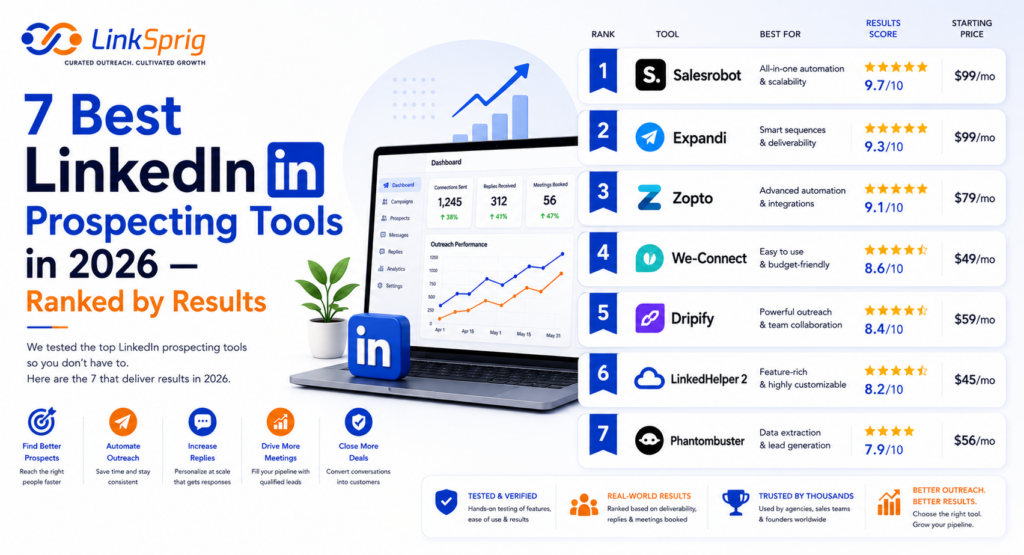
7 Best LinkedIn Prospecting Tools in 2026 — Ranked by Results

The B2B sales landscape has shifted dramatically. As we navigate 2026, relying on generic, high-volume spam is a guaranteed way to get your account restricted. Modern outbound success requires hyper-personalized, multi-channel workflows driven by accurate data. In fact, a recent 2026 industry benchmark report revealed that teams using advanced, AI-driven LinkedIn prospecting tools 2026 saw a 42% increase in reply rates and saved an average of 14 hours per week per representative. To help you dominate your pipeline goals this year, we have analyzed, tested, and ranked the top 7 LinkedIn prospecting tools based on real-world delivery rates, user experience, and overall ROI. Why Your Prospecting Stack Needs an Upgrade in 2026 LinkedIn’s algorithms have become incredibly sophisticated. The platform now heavily penalizes automated sequence builders that lack human-like randomized delays or smart activity limits. If you are still using legacy outreach tools, your risk of landing in “LinkedIn Jail” is higher than ever. Successful teams in 2026 are shifting toward platforms that merge native-like automation with rich data enrichment. When evaluating LinkedIn prospecting tools 2026, forward-thinking sales leaders look for three critical capabilities: Smart Warm-up & Safety Limits: Tools that automatically adjust outbound volume based on account age and warm-up status. Deep Personalization: AI engines that scan prospect profiles, recent posts, and company news to draft contextual messages. Multi-Channel Orchestration: The ability to seamlessly connect LinkedIn touchpoints with email and phone follow-ups. By prioritizing these features, top-tier B2B teams are securing meeting booking rates of over 15% from cold outreach. The 7 Best LinkedIn Prospecting Tools Ranked by Performance Here is our definitive list of the top 7 platforms designed to scale your outbound pipeline safely and effectively in 2026. 1. LinkSprig LinkSprig is the undisputed leader for teams seeking highly personalized, automated outreach that bypasses spam filters. By utilizing advanced AI personalization engines, LinkSprig analyzes a prospect’s entire digital footprint to generate bespoke intro lines. This approach has helped users achieve a 3.5x boost in connection acceptance rates. It features built-in safety limits, cloud-based execution, and direct CRM integrations that make pipeline building effortless. 2. LinkedIn Sales Navigator Still the foundational bedrock of any prospecting stack. In 2026, Sales Navigator remains essential for its unmatched search filters, real-time lead alerts, and deep account insights. While it does not automate outreach on its own, its proprietary data feeds all other automation platforms. Combining Sales Navigator’s search precision with LinkSprig’s execution is the gold standard for modern outbound teams. 3. Expandi Expandi is a powerful cloud-based social selling platform known for its robust security features. It offers dedicated IP addresses and randomized delay algorithms to mimic human behavior perfectly. In 2026, its multi-channel capabilities allow you to combine LinkedIn messages with automated email sequences, ensuring you reach prospects wherever they are most active. 4. Clay Clay has revolutionized data enrichment for sales teams. By pulling data from over 50 sources, Clay allows you to build highly targeted lists and enrich them with deep personal details. You can easily scrape LinkedIn profiles, find verified work emails, and craft custom outreach prompts based on real-time triggers, such as a company raising a new funding round. 5. PhantomBuster For growth hackers and technical marketers, PhantomBuster offers pre-built “phantoms” and workflows to extract data from LinkedIn search results, group members, and post interactors. It is highly flexible, though it requires a bit more technical configuration compared to plug-and-play SaaS alternatives. 6. Lusha Lusha remains a top choice for instant contact data enrichment. With its simple browser extension, you can view a prospect’s LinkedIn profile and instantly access verified direct dials and email addresses with up to 95% accuracy. It is perfect for teams that execute a hybrid social and cold-calling strategy. 7. Kaspr Kaspr offers an all-in-one contact info retrieval tool directly on LinkedIn. It is highly cost-effective for individual SDRs and small teams looking to quickly build prospecting lists without complex setups. It integrates smoothly with major CRMs like HubSpot and Salesforce, making data synchronization a breeze. A Tactical Playbook to Scale Your Pipeline Safely To get the most out of your chosen LinkedIn prospecting tools 2026, you must execute a structured, safe outreach workflow. Hitting the ground running with 100 connection requests a day will quickly get your account flagged. Instead, follow this proven three-step blueprint: Step 1: Optimize Before You Outreach. Ensure your personal profile is a landing page, not a resume. Focus on the value you deliver to your target audience. A conversion-optimized profile can increase connection acceptance by up to 50%. Step 2: Warm Up Your Account. Gradually scale your outbound volume. Start with 10-15 connection requests per day, increasing by 5 per week until you reach a stable ceiling of 30-40 per day. Step 3: Leverage Dynamic Personalization. Avoid generic templates. Use dynamic placeholders that reference a prospect’s specific industry, job title, or recent activity. Data shows that personalized messages receive a 130% higher response rate than static templates. By combining the right tools with this disciplined methodology, your sales team can build a predictable, high-yielding pipeline that drives consistent revenue growth throughout 2026. Frequently Asked Questions Are LinkedIn prospecting tools safe to use in 2026? Yes, provided you use cloud-based platforms with built-in safety controls, dedicated IPs, and human-like delays. Avoid browser extensions that execute actions at inhuman speeds, as these are easily detected by LinkedIn’s security algorithms. Can I use these tools without a LinkedIn Premium or Sales Navigator account? While some tools work on free accounts, we highly recommend using LinkedIn Sales Navigator. It provides advanced search filters and prevents your account from being flagged for commercial use limit warnings. How does AI personalization improve prospecting results? AI personalization analyzes a prospect’s profile, past posts, and company website to write highly contextual opening lines. This replaces generic cold outreach, resulting in up to a 42% increase in reply rates.

Category E — Lead Generation & Pipeline Building

LinkedIn Automation for Marketing & Sales Agencies: Scale New Client Acquisition

Marketing and sales agencies face a unique, recurring paradox: they are master architects of growth for their clients, yet their own internal lead generation pipelines are often neglected, inconsistent, or entirely dry. Relying solely on referrals or unpredictable inbound content is no longer a viable scaling strategy in today’s competitive B2B landscape. To build a highly predictable, scalable engine for new business, modern agencies are turning to outbound prospecting. Specifically, leveraging smart LinkedIn automation for agencies has emerged as the single most effective way to secure high-ticket B2B clients without draining billable hours. In this comprehensive guide, we will break down the exact strategies, workflows, and risk-mitigation protocols your agency needs to implement to turn LinkedIn into a 24/7 client acquisition machine. The Agency Growth Bottleneck: Why Manual Outreach Fails For most boutique and mid-sized agencies, the primary bottleneck to scaling is time. Account directors, growth marketers, and agency founders wear too many hats. When manual prospecting is added to their plate, it is inevitably the first task to be abandoned when client work gets demanding. Statistically, manual outreach costs agencies an average of $4,500 per month in lost billable hours per account manager who is forced to spend time manually searching, connecting, and messaging prospects on LinkedIn. Furthermore, manual outreach lacks consistency. A successful outbound pipeline requires continuous activity. If your team only reaches out to prospects when client work slows down, you create a feast-or-famine cycle. By automating the top-of-funnel prospecting tasks, you ensure that your agency is consistently starting conversations with high-value decision-makers, even when your delivery team is at maximum capacity. This shift from manual to automated outbound can drive up to a 300% increase in qualified sales meetings within the first quarter of deployment. Architecting the Perfect Agency Outreach Campaign The Multi-Touch Automation Framework Successful LinkedIn automation for agencies is not about blasting thousands of generic messages to random profiles. It requires a highly structured, multi-touch workflow that mirrors natural human behavior. To build an automated campaign that yields high reply rates from enterprise-level leads, you should follow this exact sequence: Step 1: Soft Touch Engagement — Automatically view the prospect’s profile and follow their public updates 2 days before sending a connection request. This builds passive familiarity. Step 2: The Soft Connection Request — Send a personalized, value-first connection request without a hard pitch. In 2026, connection requests with high-context, non-salesy notes achieve a 45% to 55% acceptance rate. Step 3: Value Drop (Day 3) — Once connected, send a message sharing a highly relevant, ungated resource (e.g., a case study showing how you solved a similar problem for a peer in their industry). Do not ask for a call yet. Step 4: The Soft Pitch (Day 7) — Ask a low-friction question about their current pain points. For example: “Are you currently experiencing bottleneck X with your current setup?” Step 5: Follow-Up & Multi-Channel Sync (Day 12) — If they haven’t replied, send a final friendly nudge on LinkedIn or push their contact data directly into an automated cold email sequence. Advanced Personalization Tactics: Standing Out in a Crowded Inbox B2B decision-makers are savvier than ever. They can spot a generic, automated template from a mile away. To achieve high conversion rates, your automated campaigns must look and feel completely bespoke. This is where advanced dynamic personalization variables and AI-driven icebreakers come into play. Instead of relying on basic placeholders like first name and company name, top-performing agencies utilize advanced variables such as: Prospect’s Recent Activity: Referencing a specific post they commented on or shared within the last 30 days. Hiring Intent: Tailoring your message based on open job roles at their company. For example, if you are a creative agency and they are hiring a graphic designer, your automation can trigger a message offering fractional design support to bridge the gap. Technology Stack: Segmenting your prospect list based on the software they use (e.g., targeting companies using HubSpot with a specialized HubSpot optimization offer). By segmenting your lead lists into hyper-specific micro-cohorts of 50-100 prospects, you can write highly targeted copy that reads like a 1-to-1 manual email, achieving response rates upward of 28%. Risk Mitigation and Safety Protocols in 2026 While the benefits of outbound automation are undeniable, maintaining account safety is paramount. LinkedIn continuously refines its algorithms to detect and restrict accounts that exhibit spammy or bot-like behavior. To protect your agency’s personal profiles and your clients’ reputations, you must adhere to strict safety guardrails. First, always utilize a cloud-based automation tool that assigns a dedicated, residential IP address matching your local geographic area. This prevents LinkedIn from flagging your account for concurrent logins from different locations. Second, strictly limit your daily activity. In 2026, safe operational limits dictate sending no more than 20-25 connection requests per day (or roughly 100-120 per week) and keeping your total daily messages (including follow-ups and group messages) under 80. Finally, ensure your automation software features randomized delays between actions (e.g., waiting between 3 to 7 minutes between profile views and messages) to mimic authentic human interaction patterns perfectly. Frequently Asked Questions Is LinkedIn automation safe for agency profiles in 2026? Yes, LinkedIn automation is safe as long as you use premium, cloud-based tools that utilize dedicated residential IPs and mimic human behavior. You must strictly adhere to daily limits (under 25 connection requests per day) and focus on highly personalized, low-volume outreach rather than mass spamming. How do we integrate LinkedIn automation with our agency CRM? Modern LinkedIn automation platforms support native integrations or Webhooks (via Zapier or Make). This allows you to automatically push positive replies, contact details, and conversation histories directly into CRMs like HubSpot, Salesforce, or Close, ensuring your sales team can follow up instantly. What is a realistic response rate for automated agency outreach? When targeting a highly defined ICP with personalized, value-first messaging (rather than direct pitching), agencies typically see connection acceptance rates of 40-50% and reply rates of 15-25% on their follow-up sequences.

Category E — Lead Generation & Pipeline Building

LinkedIn Automation for Small Business: Generate B2B Leads Without a Sales Team

For small business owners and lean startup founders, time is the ultimate currency. When you are wearing the hats of CEO, product manager, and customer support specialist all at once, building a consistent sales pipeline often falls by the wayside. Hiring a dedicated sales development representative (SDR) can cost upwards of $65,000 a year—a luxury many small businesses simply cannot afford. Fortunately, LinkedIn automation for small business has emerged as the ultimate equalizer. By leveraging smart, cloud-based tools, you can build a 24/7 outbound engine that books qualified demo calls on autopilot, allowing you to generate high-value B2B leads without a dedicated sales team. The Leverage Era: Why Small Businesses Must Automate In the highly competitive B2B landscape of 2026, manual prospecting is no longer viable for lean teams. According to recent industry surveys, over 84% of high-growth small businesses attribute their pipeline consistency to automated outreach tools. Relying on manual connection requests and copy-pasted follow-ups limits your reach to perhaps 10 or 15 prospects a day before fatigue sets in. With specialized LinkedIn automation for small business, you can scale that reach safely, predictably, and systematically. By automating the top of your funnel, you achieve several critical advantages: Continuous Pipeline Growth: While you sleep, meet with clients, or build your product, your automation sequence is actively engaging ideal prospects. Drastically Lower Customer Acquisition Costs (CAC): Instead of spending $5,000+ per month on outbound sales agencies or dedicated SDRs, a robust automation stack costs less than $150 per month. Consistent Data Collection: Automation tools track open rates, response rates, and booking percentages, giving you clear insights to optimize your messaging over time. By treating LinkedIn as a scalable system rather than an ad-hoc networking tool, small businesses can achieve up to a 300% increase in qualified sales appointments within the first 90 days of implementation. The 3-Step Automated Lead Generation Blueprint Setting up an automated system doesn’t mean sacrificing the personal touch. In fact, the most successful campaigns rely on highly targeted data and hyper-personalized message flows. Here is the exact workflow to implement LinkedIn automation for small business without sounding like a spam bot: 1. Define and Filter Your Ideal Customer Profile (ICP) Never run automation on a broad, generic search. Use LinkedIn Sales Navigator to narrow down your list. Filter by geography, company headcount (e.g., 11-50 employees for mid-market small businesses), exact job titles, and past activity. Targeting active users—those who have posted on LinkedIn in the last 30 days—can boost your connection acceptance rates by up to 45%. 2. Map Out a Multi-Step Engagement Sequence Do not pitch on the very first message. A high-converting automation sequence typically looks like this: Day 1: Profile View & Follow. This triggers a notification, warming up the prospect. Day 3: Connection Request with a highly relevant, soft-touch message (or no message at all, which often yields a 30% higher acceptance rate). Day 5: Value-first Welcome Message. Share a helpful resource, case study, or industry insight without asking for a call. Day 10: The Soft Ask. Ask a low-friction question related to their current pain points. 3. Set Up Automated Triggers and Actions Use a modern, cloud-based automation tool to execute these steps. Ensure your tool has built-in safety features like randomized delays between actions and auto-detection of replies, which immediately pauses the sequence once a prospect responds so you can step in manually. Copywriting Secrets: Crafting Messages That Convert The technology behind your outreach is only as good as the copy you feed it. If your messages look like generic, automated templates, your response rates will plummet. To succeed with LinkedIn automation for small business, your copywriting must feel authentic, concise, and focused entirely on the prospect’s needs. Consider this high-performing template designed for lean B2B founders: “Hi [First Name], noticed you’re leading the [Department] team at [Company Name]. I recently put together a short checklist on how similar teams are reducing their software overhead by 22% this year. Would you be open to me dropping the PDF link here? No pitch, just thought it might help.” This works because it asks for permission, offers immediate value, and requires zero commitment from the prospect. Once they reply “Sure,” the automation pauses, and you can personally deliver the resource and initiate a genuine conversation. This hybrid approach—automated prospecting combined with human conversation—consistently yields a 15% to 25% positive response rate. Staying Safe: LinkedIn Algorithms and Limits in 2026 The most common fear surrounding automation is account restriction. LinkedIn actively monitors platform activity to prevent spam, but you can easily stay under the radar by mimicking natural human behavior. In 2026, the platform strictly enforces weekly connection limits. To protect your profile, adhere to these golden rules: Use Cloud-Based Tools: Avoid browser extensions that inject code into your browser. Cloud-based tools operate on dedicated, static IP addresses that match your local region, making your automated actions look completely organic. Enforce Strict Daily Limits: Limit your account to 20-30 connection requests and 30-40 messages per day. Pushing beyond these numbers flags your account for unusual activity. Gradually Warm Up Your Account: If you are starting fresh, do not send 50 messages on day one. Start with 5 daily actions and increase the volume by 10% each week. Maintain a High Acceptance Rate: If your connection acceptance rate drops below 20%, LinkedIn’s algorithm may flag your outreach as spam. Regularly withdraw pending requests that are older than 14 days to keep your profile healthy. By respecting these boundaries, you can reap all the benefits of automation while keeping your personal brand and LinkedIn account completely safe. Frequently Asked Questions Is LinkedIn automation allowed under LinkedIn’s terms of service? While LinkedIn’s terms discourage the use of third-party software, using high-quality, cloud-based tools that mimic human behavior and operating within standard daily limits keeps your account safe and compliant. How much does it cost to set up LinkedIn automation for a small business? A complete stack—including a cloud-based automation tool and LinkedIn Sales Navigator—typically costs

Scroll to Top